Fertility Crisis: One Man’s Contribution to Save Japan

As Japan's population clock ticks downward, one American in Tokyo stands ready with open arms to help reverse the trend.
In the land of the rising sun, the sun is also setting on Japan's population. Births hit a dismal record low of 671,236 in 2025 — the tenth straight year of decline — while the fertility rate sank to 1.14, far below the 2.1 replacement level needed for stability. Deaths outpaced births by over 918,000, shrinking the workforce, straining pensions, and prompting frantic government incentives that have so far failed to spark a turnaround.
Enter Jake Murphy, a 32-year-old American expat from Ohio now living in a cozy Shibuya apartment. Jake, a self-described "demographic enthusiast" and part-time English tutor, has studied the data and arrived at a bold, hands-on solution.
"Japan's tried cash bonuses, longer parental leave, and robot nannies," Jake explains earnestly over matcha lattes. "But nothing beats good old-fashioned... international cooperation. I'm here to do my part—one revitalization effort at a time.”
Jake’s plan is simple, upbeat, and laser-focused on what he calls “prime fertility years”—because he feels “Japan doesn’t have time to waste.” He spends his weekends “networking” at cherry blossom festivals and sake bars, carefully bypassing anyone who might be considered past their peak productivity phase, typically striking up conversations with visually high-performing Japanese women in their 20s. His pitch? A cultural exchange with benefits. “Think of it as foreign aid,” he says. “I provide energy, optimism, and excellent genes. They provide the future continuation of the Samurai Kingdom. Time is of the essence! Win-win for the crisis-stricken empire!”
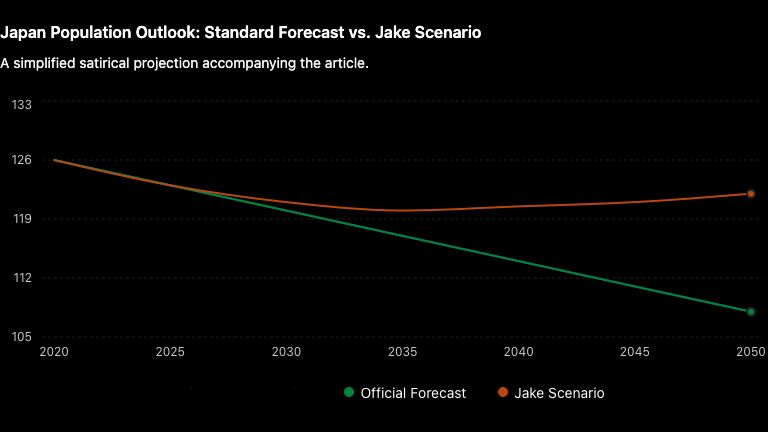 According to Jake's meticulously color-coded spreadsheets, the impact could be huge. "If I help bring even 50-100 new citizens into the world over the next decade, that's a measurable dent in the 900,000+ annual shortfall," he beams. "Each kid gets a 50% boost in genetic diversity — hybrid vigor, they call it in science circles! Studies show diverse gene pools lead to stronger immune systems, better adaptability, and all-around heartier populations. Japan gets a fresh Midwest splash in the family tree. No more worrying about homogeneity — we're talking resilient kids who might invent the next bullet train or win Olympic gold in Judo!”
Friends describe Jake as tireless. He maintains a color-coded calendar, hits the gym religiously ("gotta stay viable!"), and keeps a polite but persistent Facebook Group for "follow-up stork consultations." No pressure, of course—just lots of laughter, shared karaoke nights, and gentle reminders that Japan's future needs more citizens with half-Kansai, half-Midwest charm.
Government officials have not yet endorsed Jake's grassroots initiative, but he remains optimistic. "They're spending billions on policies," he shrugs. "Me? I'm doing the hard work. Literally.”
As Japan's population clock ticks downward, one American in Tokyo stands ready—with open arms and an even more open schedule—to repopulate the empire, one delightful rendezvous at a time. Japan may be shrinking, but Jake's ambition (and spreadsheets) are expanding exponentially. Ganbatte, Jake-san! A nation (quietly) thanks you.
Based on articles published by asahi.com, bioone.com, macrotrends.net, NBC News, and ScienceDirect
Enter Jake Murphy, a 32-year-old American expat from Ohio now living in a cozy Shibuya apartment. Jake, a self-described "demographic enthusiast" and part-time English tutor, has studied the data and arrived at a bold, hands-on solution.
"Japan's tried cash bonuses, longer parental leave, and robot nannies," Jake explains earnestly over matcha lattes. "But nothing beats good old-fashioned... international cooperation. I'm here to do my part—one revitalization effort at a time.”
Jake’s plan is simple, upbeat, and laser-focused on what he calls “prime fertility years”—because he feels “Japan doesn’t have time to waste.” He spends his weekends “networking” at cherry blossom festivals and sake bars, carefully bypassing anyone who might be considered past their peak productivity phase, typically striking up conversations with visually high-performing Japanese women in their 20s. His pitch? A cultural exchange with benefits. “Think of it as foreign aid,” he says. “I provide energy, optimism, and excellent genes. They provide the future continuation of the Samurai Kingdom. Time is of the essence! Win-win for the crisis-stricken empire!”
According to Jake's meticulously color-coded spreadsheets, the impact could be huge. "If I help bring even 50-100 new citizens into the world over the next decade, that's a measurable dent in the 900,000+ annual shortfall," he beams. "Each kid gets a 50% boost in genetic diversity — hybrid vigor, they call it in science circles! Studies show diverse gene pools lead to stronger immune systems, better adaptability, and all-around heartier populations. Japan gets a fresh Midwest splash in the family tree. No more worrying about homogeneity — we're talking resilient kids who might invent the next bullet train or win Olympic gold in Judo!”
Friends describe Jake as tireless. He maintains a color-coded calendar, hits the gym religiously ("gotta stay viable!"), and keeps a polite but persistent Facebook Group for "follow-up stork consultations." No pressure, of course—just lots of laughter, shared karaoke nights, and gentle reminders that Japan's future needs more citizens with half-Kansai, half-Midwest charm.
Government officials have not yet endorsed Jake's grassroots initiative, but he remains optimistic. "They're spending billions on policies," he shrugs. "Me? I'm doing the hard work. Literally.”
As Japan's population clock ticks downward, one American in Tokyo stands ready—with open arms and an even more open schedule—to repopulate the empire, one delightful rendezvous at a time. Japan may be shrinking, but Jake's ambition (and spreadsheets) are expanding exponentially. Ganbatte, Jake-san! A nation (quietly) thanks you.
Based on articles published by asahi.com, bioone.com, macrotrends.net, NBC News, and ScienceDirect