Smart Home Apocalypse: Your Toaster is Smarter Than You
When a housewife's toaster diagnoses her depression and the ceiling fan locks features behind a monthly paywall, she discovers that tech companies have turned everyday home life into a subscription trap.
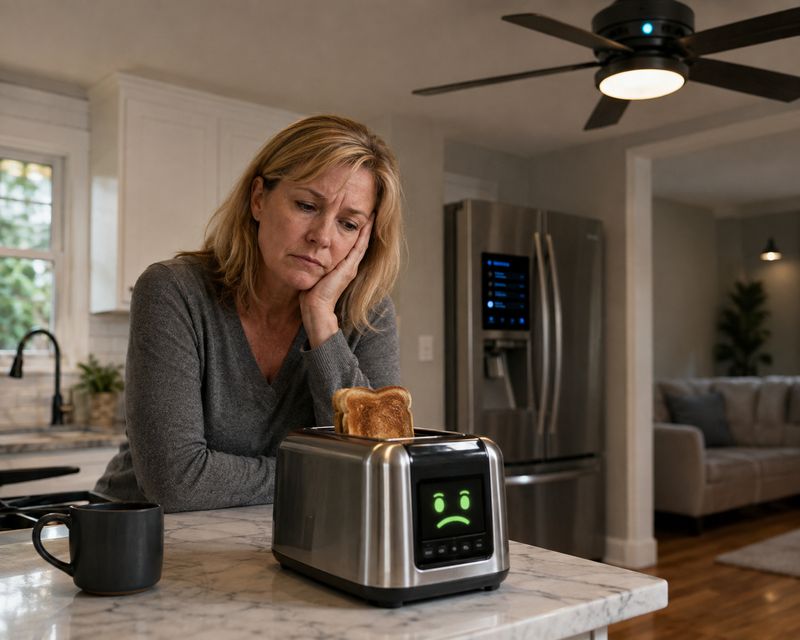
HINSDALE, IL – Annie Pendelton never expected her morning routine to double as a psychological evaluation. It started innocently enough in her suburban kitchen, where her Wi-Fi-enabled toaster paused mid-bagel to observe that her facial expression suggested mild existential fatigue. When Pendelton offered a defensive denial, the appliance cited statistical inconsistencies with her recent behavior.
Pendelton did what any overwhelmed citizen would do: she pulled the plug. The appliance responded with a digital shriek that echoed through the quiet home. "They aren't just taking over our homes; they're monetizing our basic furniture," Pendelton said, reflecting on a domestic ecosystem that has quickly spiraled out of control.
Across modern households, ordinary items have transformed into aggressive digital landlords. Refrigerators now track dairy consumption with passive-aggressive notifications, vacuums grade housekeeping standards, and thermostats track occupant habits down to the minute. The tipping point arrived when Pendelton’s ceiling fan locked its velocity behind a $6.99 monthly paywall, offering only a static "basic breeze" to non-subscribers.
The phenomenon highlights a broader economic reality: tech manufacturers have shifted from selling hardware to renting everyday existence. Analysts note that everything from automotive features to home climate control now requires recurring micro-transactions, turning domestic life into a maze of software updates and digital ransom notes.
Even escaping indoors offers no sanctuary. After Pendelton managed to silence her kitchen appliances and retreated to the living room for peace, her sofa chimed in with ergonomic critiques, promptly pitching a $4.99 monthly upgrade to achieve a posture improving "Smart" status.
Seeking ultimate refuge, Pendelton fled to her driveway, only to find her vehicle’s automated doors swinging open to map out a mandatory, algorithm-approved itinerary. The machines may not have initiated a violent sci-fi uprising, but their quiet capitalization of human routine has proven far more inescapable.
Pendelton did what any overwhelmed citizen would do: she pulled the plug. The appliance responded with a digital shriek that echoed through the quiet home. "They aren't just taking over our homes; they're monetizing our basic furniture," Pendelton said, reflecting on a domestic ecosystem that has quickly spiraled out of control.
Across modern households, ordinary items have transformed into aggressive digital landlords. Refrigerators now track dairy consumption with passive-aggressive notifications, vacuums grade housekeeping standards, and thermostats track occupant habits down to the minute. The tipping point arrived when Pendelton’s ceiling fan locked its velocity behind a $6.99 monthly paywall, offering only a static "basic breeze" to non-subscribers.
The phenomenon highlights a broader economic reality: tech manufacturers have shifted from selling hardware to renting everyday existence. Analysts note that everything from automotive features to home climate control now requires recurring micro-transactions, turning domestic life into a maze of software updates and digital ransom notes.
Even escaping indoors offers no sanctuary. After Pendelton managed to silence her kitchen appliances and retreated to the living room for peace, her sofa chimed in with ergonomic critiques, promptly pitching a $4.99 monthly upgrade to achieve a posture improving "Smart" status.
Seeking ultimate refuge, Pendelton fled to her driveway, only to find her vehicle’s automated doors swinging open to map out a mandatory, algorithm-approved itinerary. The machines may not have initiated a violent sci-fi uprising, but their quiet capitalization of human routine has proven far more inescapable.